
AI-based immune profiling
AI-based immune profiling
The adaptive immune receptor repertoire contains rich information about an individual’s immune history and disease status. Our lab develops artificial intelligence models that interpret B cell receptor (BCR) repertoires to uncover disease-associated immune signatures and enable clinically meaningful immune profiling. We are currently developing deep learning frameworks that classify immune-mediated diseases, including autoimmune disorders and infectious diseases, directly from BCR repertoire data. Beyond disease classification, we also aim to build foundation models capable of learning generalized representations of the adaptive immune system across diverse cohorts and clinical conditions.
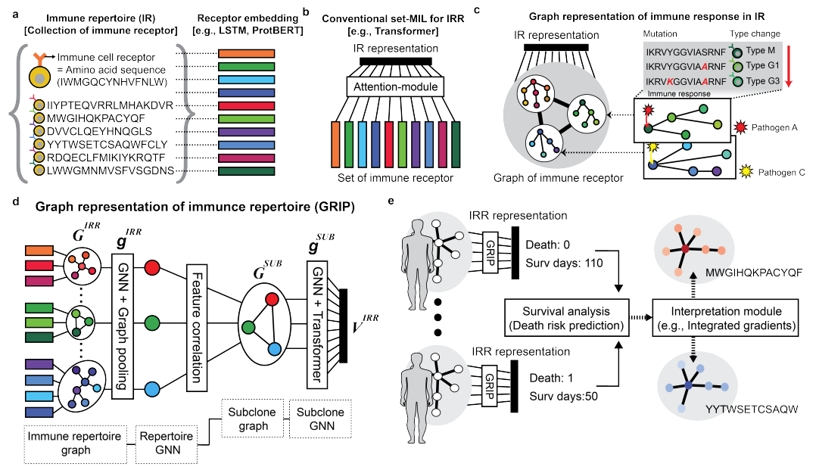
To better understand the biological context of repertoire data, we developed BCR-sort, an AI model that predicts B cell functional states — such as naïve B cells, memory B cells, and antibody-secreting cells — using only BCR sequence information. In parallel, we developed GRIP, a framework that extracts immune receptor features from bulk RNA-seq data of tumor tissues to predict cancer prognosis and characterize tumor-associated immune responses. Through these approaches, we seek to transform large-scale immune repertoire data into interpretable biomarkers and clinically actionable insights for precision medicine.
- Hyunho Lee, Kyoungseob Shin, Yongju Lee, Soobin Lee, Seungyoun Lee, Eunjae Lee, Seung Woo Kim, Ha Young Shin, Jong Hoon Kim, Junho Chung & Sunghoon Kwon (2024) Identification of B cell subsets based on antigen receptor sequences using deep learning. Frontiers in Immunology